Transforming your empty roof space into a highly active renewable power plant is a brilliant financial strategy. It actively insulates your household budget against constantly rising state utility tariffs.
However, placing delicate electrical infrastructure on top of a two story building introduces a massive maintenance challenge. Unlike ground mounted solar arrays that you can simply wipe down while standing on the grass, rooftop panels are incredibly difficult and dangerous to reach.
Many homeowners make the fatal assumption that their rooftop system is entirely self cleaning. They believe heavy seasonal rain will wash away the accumulated dirt. This is a massive financial misconception.
Rainwater actively collects airborne dust and smog as it falls through the atmosphere. When it dries on your hot glass panels, it leaves behind a thick, dark residue that physically blocks the sun.
If you ignore routine rooftop maintenance, your highly expensive panels will suffer a massive drop in electrical efficiency. You will lose hundreds of units of generated power every single year. To protect your green energy investment and keep your monthly utility bills at absolute zero, you must take physical action.
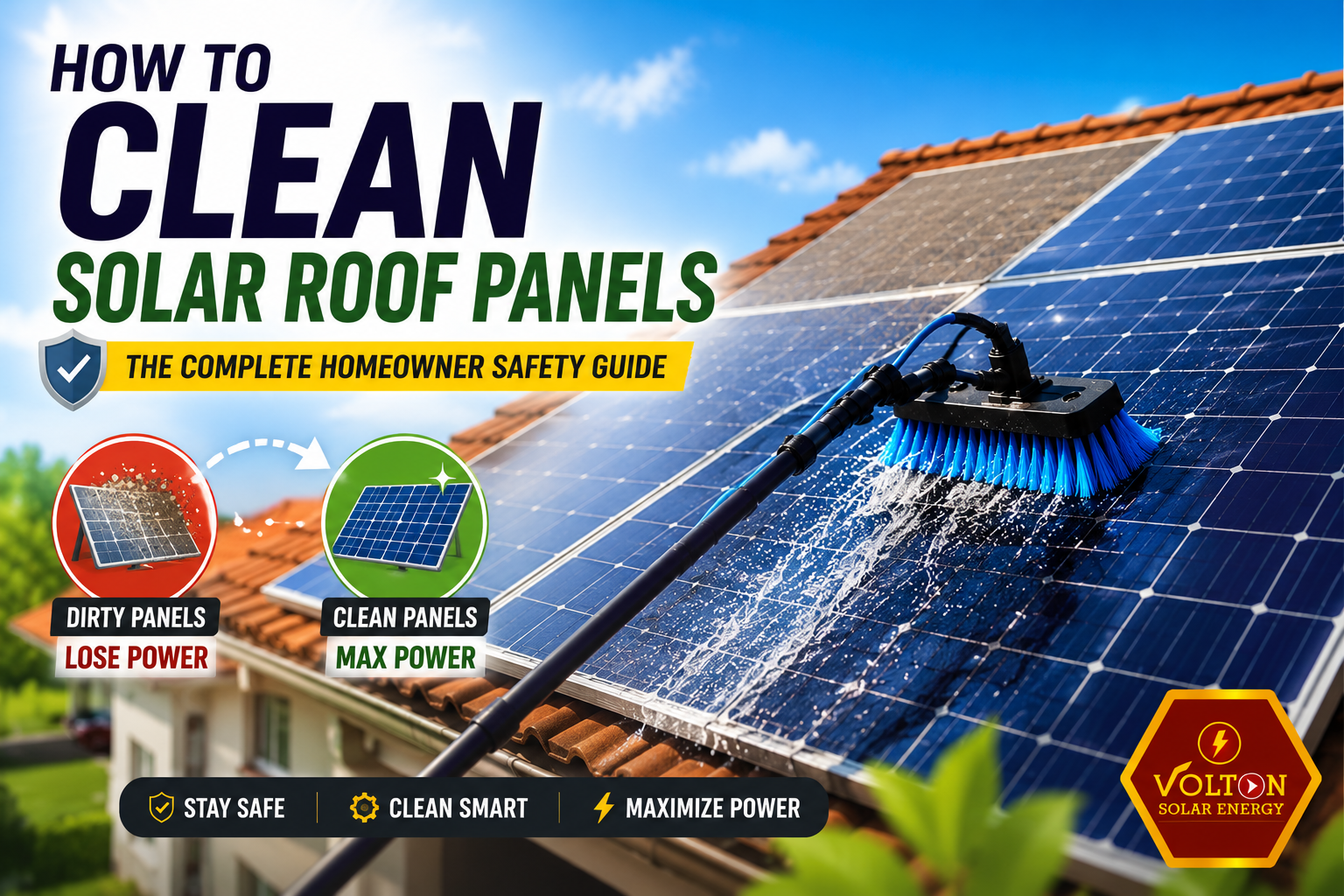
This comprehensive 1500 word guide details exactly how to clean solar roof panels, the mandatory safety equipment you must use, and the strict physical protocols required to execute the job without damaging your property or risking a fatal fall.
The Unique Hazards of Rooftop Debris
Cleaning a roof mounted solar array is completely different from washing a ground level system because of the specific types of dirt involved. Your roof acts as a massive physical net that catches highly localized debris. Understanding exactly what is blocking your solar cells dictates how you must clean them.
Chimney Soot and Ash: If your home features an active winter fireplace, your solar panels are in direct danger. Chimney soot is heavily oily and highly acidic. When the wind blows this soot across your roof, it binds to the anti reflective coating on your solar panels. Normal water will not wash this off. It requires highly specific soft brush agitation to break the greasy physical bond.
Roof Moss and Lichen: Older asphalt shingle roofs are notorious for growing heavy green moss in damp, shaded areas. Over time, this moss creeps directly onto the aluminum mounting frames of your solar panels. Lichen is even worse. It creates a hard crust directly on the tempered glass, completely blinding the silicon cells beneath it. Scraping this off requires immense patience and the correct non abrasive tools.
Trapped Organic Debris: The physical gap between your roof tiles and the solar panels creates a perfect trap for autumn leaves, pine needles, and stray twigs. As this organic matter decays under the panels, it attracts nesting birds and destructive rodents that will aggressively chew through your highly sensitive DC wiring.
The Absolute Necessity of Fall Protection
Before you even think about buying a cleaning brush, you must establish a strict safety protocol. Gravity is highly unforgiving. A fall from a standard two story roof is often fatal. You must treat this maintenance task exactly like a professional high altitude construction job.
If you are planning to physically climb onto the roof surface, you must invest in an industrial grade fall arrest system. This includes a heavy duty full body harness, a shock absorbing lanyard, and a secure metal roof anchor.
You must permanently screw the metal anchor directly into the heavy wooden trusses beneath your roof tiles. Never anchor yourself to the actual solar panel frames or the aluminum mounting rails. They are completely unsuited for supporting human body weight during a violent fall.
Your ladder setup is equally critical. You must follow strict industrial safety guidelines when placing your extension ladder against the gutters. The base of the ladder must be placed exactly one foot away from the wall for every four feet of vertical height.
Furthermore, the top of the ladder must extend at least three solid feet above the edge of the roof. This provides a highly stable physical handhold when you are transitioning from the ladder onto the steep roof surface.
If possible, install a specialized ladder standoff bracket to prevent the heavy metal rails from crushing your expensive aluminum rain gutters.
Ground Based Cleaning: The Safest Alternative
The absolute safest way to clean solar panels on a roof is to stay off the roof entirely. If you have a single story home or an easily accessible lower roof section, you can execute the entire cleaning process while standing firmly on the ground.
To achieve this, you must invest in an extreme length telescoping carbon fiber pole. Carbon fiber is mandatory here. Heavy aluminum poles become incredibly difficult to control when extended past twenty feet, and they will severely strain your back muscles. A carbon fiber water fed pole is incredibly lightweight and highly rigid.
It allows you to reach the absolute top row of your rooftop array while your feet remain safely planted on the grass. You simply connect your pure water source to the base of the pole, and the water flows internally all the way up to the soft bristle brush head.
The Professional Rooftop Cleaning Toolkit
You cannot attack your expensive solar infrastructure with heavy garage brooms and highly abrasive household detergents. The tempered glass features an incredibly fragile chemical coating designed to maximize light absorption. Using the wrong physical tools will permanently scratch the glass and instantly destroy your electrical output.
Pure Deionized Water Systems
Never drag a standard municipal garden hose onto your roof for the final rinse. Tap water is completely loaded with microscopic calcium and magnesium particles. When standard tap water evaporates under the hot sun, it leaves behind dense white mineral spots.
These spots are incredibly difficult to remove and block sunlight just as aggressively as bird droppings. You must use a deionized water filtration tank. Deionized water is completely pure. It acts as a chemical magnet, pulling dirt directly off the glass and evaporating completely spotless.
Non Abrasive Brush Heads
Your water fed pole must be equipped with a specialized solar cleaning brush. The bristles must be incredibly soft and heavily flagged at the ends. Flagged bristles are split into multiple tiny fibers, allowing them to gently agitate thick dirt without leaving microscopic scratches across the expensive tempered glass.
Soft Rubber Squeegees
If you do not have access to a deionized water system, you absolutely must use a professional grade window squeegee. You have to manually pull every single drop of hard tap water off the glass before the ambient heat causes it to evaporate and form permanent mineral stains.
Step by Step: How to Clean Solar Panels on Roof
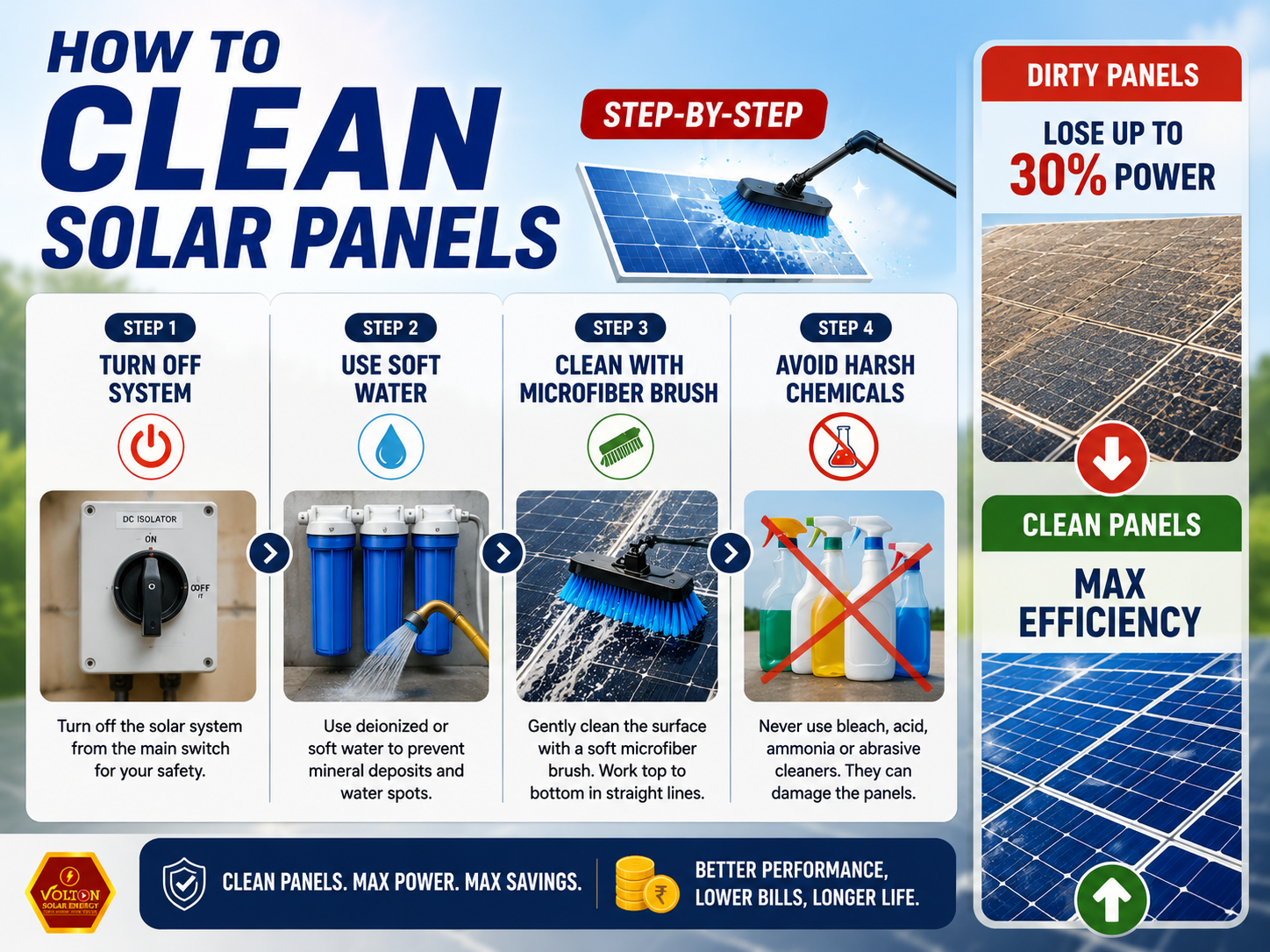
If you have secured your safety harness and assembled your pure water toolkit, you are ready to execute the physical cleaning. Follow this exact operational sequence to ensure maximum efficiency and total hardware safety.
Step 1: Strict Temperature Control
You must time your maintenance perfectly. Never attempt to wash your panels during the middle of the afternoon. The dark silicon cells absorb massive amounts of solar radiation and become physically hot to the touch.
If you spray cold water onto boiling hot tempered glass, the extreme temperature shift will cause massive thermal shock.
The glass will instantly shatter into thousands of pieces, and your manufacturer warranty will be completely voided. Always execute your cleaning at early dawn or late dusk when the hardware is entirely cool.
Step 2: The Pre Soaking Phase
Before you start scrubbing, you must soften the baked dirt. Use your water fed pole to gently spray down the entire rooftop array. Let the water sit on the glass for exactly five minutes.
This critical soaking period rehydrates heavy bird droppings and loosens stubborn tree sap, making the actual brushing phase significantly easier and much safer for the glass.
Step 3: Top to Bottom Agitation
Always start cleaning at the absolute highest row of your solar array. Gently glide your soft bristle brush horizontally across the panels. Do not apply heavy downward physical pressure. Let the soft bristles and the constant flow of pure water do the heavy lifting.
As you clean the top row, the dirty water will naturally flow down and pre-wash the lower panels. Work your way methodically down the roof until every single panel has been agitated.
Step 4: Clearing the Aluminum Frames
Pay highly specific attention to the bottom edge of every single panel. The aluminum frame creates a small physical lip where water naturally pools.
As the water evaporates, it leaves behind a thick strip of highly concentrated dirt right at the edge of the silicon cells. You must actively scrub this specific frame line to ensure no shading occurs at the bottom of the module.
Step 5: The Final Spotless Rinse
Once the entire array has been agitated, lift your brush head slightly off the glass. Use the pure deionized water flowing from the jets to give the entire system one final, high volume rinse.
Because you are using completely pure water, you do not need to manually dry the panels. You can safely let the air dry under the morning sun without fearing any hard water stains.
Navigating Specific Roofing Materials
Your safety heavily depends on the physical material beneath your feet. Different roofing materials require completely different movement strategies.
If you have a standard asphalt shingle roof, you must walk incredibly softly. Aggressive pivoting or heavy stomping will strip the protective gravel granules right off the shingles, causing massive future roof leaks.
If you have a metal standing seam roof, you must exercise extreme caution. Metal roofs become incredibly slick and dangerous the moment they get wet. You must wear specialized soft rubber roofing boots to maintain physical traction.
If your home features authentic clay or terracotta tiles, you should absolutely avoid walking on the roof entirely. Clay tiles are highly fragile and will instantly snap under human body weight.
Replacing broken clay tiles located directly underneath a solar array is an incredibly expensive and time consuming nightmare. For clay tile roofs, strictly stick to ground based telescoping poles.
Recognizing When to Hire Professional Crews
There is absolutely no shame in admitting that a specific rooftop is simply too dangerous to navigate. Protecting your green energy investment is important, but your physical life is infinitely more valuable.
You should immediately hire a certified professional solar maintenance company if your property meets any of the following extreme criteria. First, if your home is three stories high, the fall risk is simply too severe for amateur safety gear.
Second, if your roof pitch is incredibly steep, maintaining physical balance while wrestling with a heavy water hose is nearly impossible.
Finally, if you lack the physical upper body strength to safely maneuver a twenty foot carbon fiber pole from the ground, you must outsource the labor.
Professional crews possess highly advanced safety riggings, truck mounted deionized water filtration plants, and hydraulic lifts. They can safely and flawlessly clean a massive rooftop array in less than an hour.
In such cases, working with Volton Solar Energy ensures your system warranty remains intact, your subsidy process is handled correctly, and your installation continues to perform at peak efficiency.
Paying a minor seasonal fee for professional maintenance guarantees your solar panels operate at maximum financial efficiency without putting your personal safety at risk.
Need Help with Solar? We’re Here for You
Get FREE help for installation, cleaning, subsidy guidance, or any solar queries — talk to our expert team and get the right advice today.