Every single month, rising electricity bills are actively breaking household budgets. People are desperately looking for a permanent financial solution to escape these heavy grid tariffs. Installing renewable energy is the obvious answer. But the moment you start researching the hardware, you hit a massive wall of technical confusion. You are immediately forced to choose between an on grid vs off grid solar system, and sometimes a highly complex hybrid option.
Picking the wrong setup can completely ruin your financial return on investment. The best solar system for home use strictly depends on your local power supply reliability, your available capital, and whether you want government funding. There are three main solar system types available in the market today.
This guide completely breaks down the hard facts, the hidden maintenance costs and the exact benefits of each setup so you can make an informed financial decision.
What is an On-Grid Solar System?
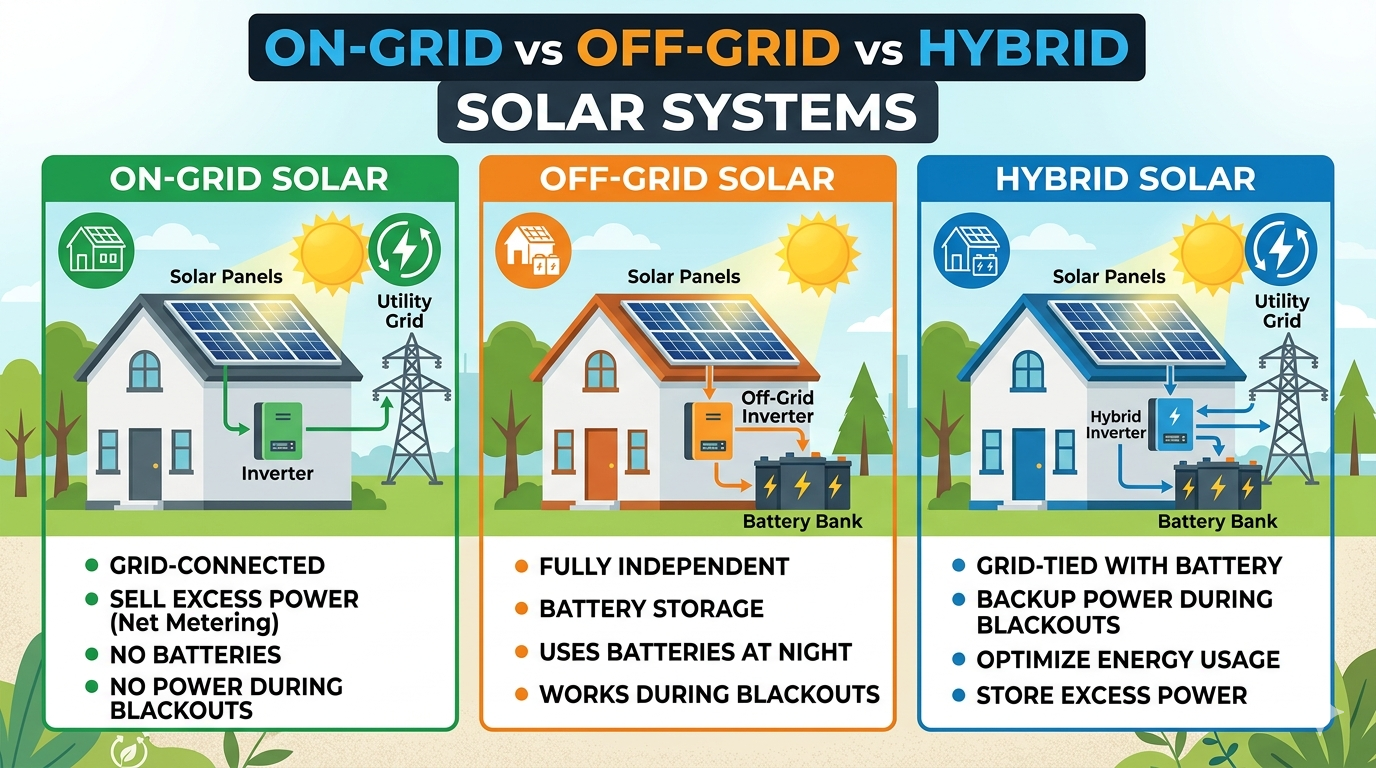
An on grid solar system is by far the most popular residential choice across the country. As the name suggests, this specific setup remains directly connected to your local utility grid. When the sun is shining, your panels generate clean electricity to run your household appliances. If your system produces more power than you are currently using, the excess electricity is automatically sent back out to the main grid. Your local electricity board tracks this via a bidirectional net meter and applies a financial credit to your account.
Because you rely on the main grid for nighttime power or during heavy rain storms, you do not need to buy expensive battery banks.
- Connected to electricity grid: Operates in sync with your state utility provider.
- No batteries required: Completely avoids the high cost of chemical storage.
- Lowest cost: The cheapest initial capital investment required.
- Eligible for government subsidy: Fully qualifies for the massive PM Surya Ghar cash grant.
Best for homes with regular electricity supply: This is absolutely the best solar system for home owners living in urban areas with highly stable power. If you rarely experience long power cuts, this setup offers the fastest financial payback.
What is an Off-Grid Solar System?
An off grid solar system is a completely independent power plant built directly on your property. This setup has zero connection to your local utility grid. Because you cannot pull emergency electricity from the state during the night, you are absolutely forced to store your own power. This means you must purchase and install a heavy, high capacity battery bank.
During the day, the solar panels power your home and simultaneously charge the massive battery bank. At night, your house pulls power directly from those stored batteries. While it offers total energy independence, the financial cost is significantly higher due to the expensive battery replacements needed over the total lifespan of the system.
- Completely independent: Zero reliance on state utility companies.
- Requires batteries: Mandatory storage required for nighttime electricity.
- Higher cost: Massive upfront capital needed for heavy battery banks.
- No subsidy: The government does not subsidize these independent setups.
Best for remote areas: This setup is strictly designed for isolated properties, rural farmhouses, or deep valley regions where the state electricity grid has simply not reached yet.
What is a Hybrid Solar System?
A hybrid solar system literally gives you the best of both worlds. It perfectly combines the reliable grid connection of an on-grid setup with the highly secure battery backup of an off-grid system. Under normal sunny conditions, it works exactly like an on-grid plant, utilizing solar power and actively exporting the excess to the state grid for financial credits.
However, when a massive power cut hits your neighborhood, the system instantly isolates itself from the dead grid and seamlessly switches to your private battery backup. Your essential appliances keep running without a single interruption. It offers total energy flexibility and heavily reduced dependency on failing state infrastructure.
- Combination of both: Features grid exporting and battery storage.
- Works during power cuts: Your lights stay on when the neighborhood goes dark.
- Expensive but reliable: Higher upfront cost for total peace of mind.
- Power backup: Dedicated storage for critical household appliances.
- Energy flexibility: Automatically manages the cheapest power source.
- Reduced dependency: Protects you from severe grid failures.
Best for areas with frequent power cuts: If your neighborhood suffers from daily voltage drops or highly scheduled power outages, a hybrid setup ensures your daily routine is never disrupted.
You May Also Like: Solar Panel Yojana: Complete Guide to PM Surya Ghar Scheme, Subsidy, Eligibility & Apply Process
On-Grid vs Off-Grid vs Hybrid: Quick Comparison
Understanding the core differences helps you protect your capital investment. Here is a rapid breakdown of how the three distinct systems compare against each other in real world conditions.
- Cost: On-grid is the cheapest option. Hybrid is highly expensive. Off-grid requires the most heavy capital overall.
- Battery: Only hybrid and off-grid setups require a physical battery bank for storage.
- Subsidy: The government only provides direct cash subsidies for standard on-grid systems.
- Backup: Hybrid and off-grid systems will keep your lights on during a total grid failure. Standard on-grid systems are legally required to shut down for grid safety.
Expert Recommendation: Which Solar System is Best?
For the vast majority of residential homeowners, we strictly recommend the standard on-grid system. It is mathematically the smartest financial decision you can make. It requires the lowest initial capital, strictly avoids the recurring cost of replacing dead batteries every five years, and offers a much faster return on investment. Most importantly, it is the only setup that legally qualifies for the massive cash subsidies currently offered by the government.
- Lower cost
- Subsidy eligible
- Faster ROI
Why Choose Volton Solar Energy in Srinagar?
Finding a highly trusted solar company in Srinagar is crucial to protecting your green energy investment. You need a dedicated local team that understands the harsh valley winters and local grid regulations.
- Local expertise: We know exactly how to handle heavy snow loads and low winter sunlight.
- Customized solutions: Every single roof gets a unique, structurally sound engineering design.
- High-quality installation: We strictly use tier one panels and highly robust mounting structures.
- Support & warranty: We provide rapid local maintenance and honor all long term performance warranties.
To Know More Read: Why Choose Volton Solar Energy
Get Expert Solar Consultation Today
Stop letting rising utility tariffs drain your bank account. If you are looking for highly professional solar panel installation in Srinagar, contact Volton Solar Energy right now. Call our local team today to secure your completely free physical site survey and let our engineers design the perfect energy system for your property.
You May Also Like: Solar Panel Subsidy Complete Guide to Amount, Eligibility & Apply Process