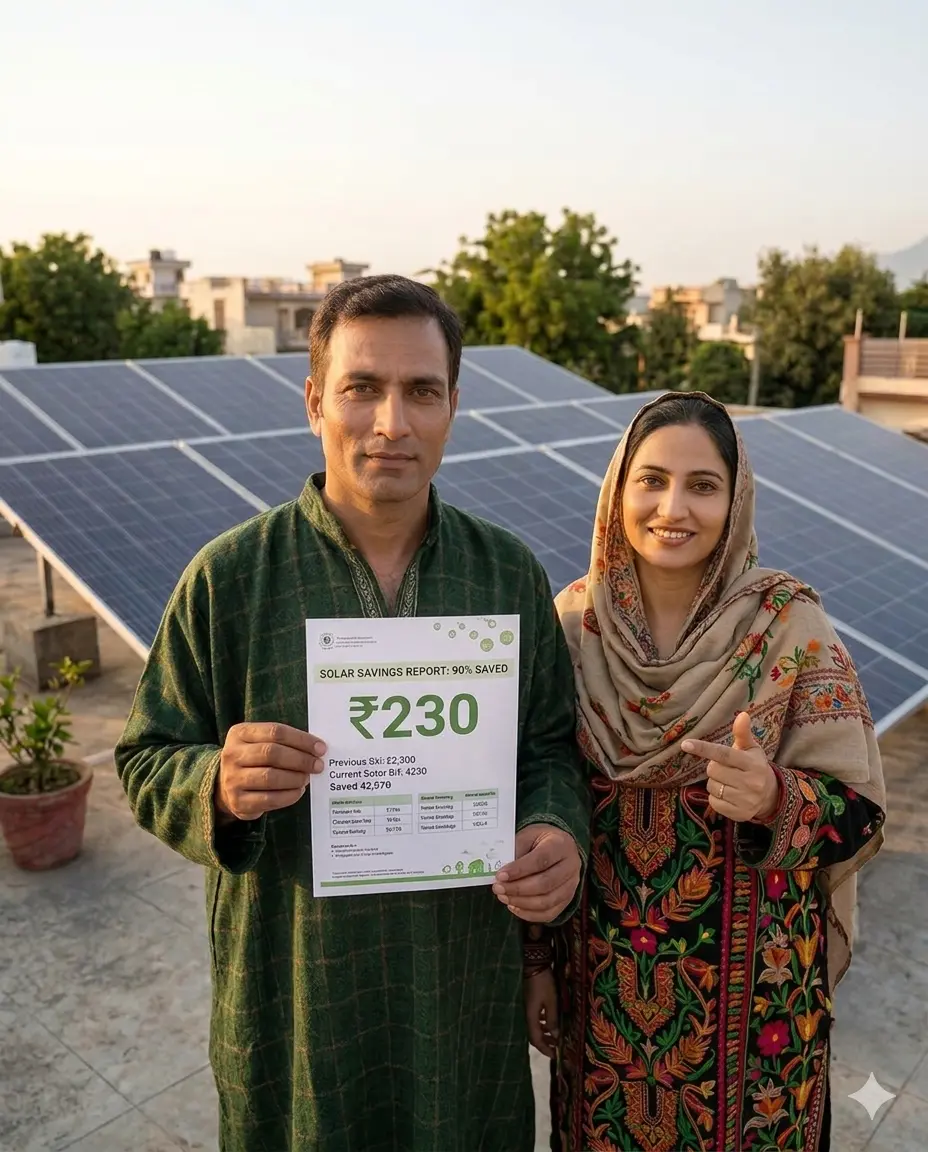
Household utility bills are currently surging at an unprecedented rate across the country. As state electricity boards steadily increase their per unit taxes, millions of homeowners are looking for a permanent financial escape route. This sudden panic has caused a massive spike in searches related to any official solar yojana India has to offer.
The central government has completely overhauled its renewable energy strategy for the 2026 financial year. They are actively injecting billions of rupees directly into the residential sector to reduce the massive load on traditional coal power plants. However, the internet is currently flooded with highly misleading WhatsApp forwards and fake registration portals. People are confused about the real subsidy numbers & the actual application process.
This comprehensive guide cuts through the online noise. We are breaking down the exact financial metrics, the strict legal eligibility rules & the step by step portal instructions you need to successfully secure your government funding this year.
What is Solar Panel Yojana?
There is a lot of online confusion regarding the actual name of the government programme. When citizens type the popular search phrase “What is Solar Panel Yojana” into Google they are usually looking for a simple explanation of the national subsidy framework.
In strict financial terms, it is not just one single scheme. It is a broad public umbrella term used to describe a highly structured government incentive programme. The primary goal is to convince everyday homeowners to install renewable energy systems on their private rooftops.
Because the initial hardware and installation costs are incredibly high, the government steps in to cover a massive chunk of your final invoice. The state essentially pays you to generate your own clean electricity. By drastically lowering the upfront financial barrier, the government hopes to build a massive, decentralised power grid across millions of residential homes. You buy the tier one solar equipment, the state refunds a large percentage of your capital, and you secure zero cost electricity for the next two decades.
Latest Government Solar Schemes in India
The Ministry of New and Renewable Energy recently streamlined its entire public offering. They scrapped several overlapping regional policies to create a highly unified national framework. All this information can be found out at https://mnre.gov.in/.
For the agricultural & rural farming sector the PM KUSUM initiative remains the dominant funding source (https://pmkusum.mnre.gov.in/). This specific programme heavily subsidises independent solar water pumps, allowing local farmers to completely ditch expensive diesel generators.
However, for the residential housing market, the entire financial focus has shifted to the brand new pm surya ghar yojana. This is the absolute flagship policy for 2026. The government has aggressively consolidated all previous state level rooftop subsidies directly into this single, massive central portal. If you own a standard urban house or a rural domestic property, this is the exact government scheme you must target to secure your capital grant.
“PM Surya Ghar Yojana” Explained
The financial scale of this specific programme is absolutely staggering. The PM Surya Ghar Muft Bijli Yojana launched with a massive ₹75,021 crore central budget. The primary political and economic objective is to fully equip 10 million individual households with modern rooftop solar infrastructure.
The core promise driving this massive public adoption is the guarantee of up to 300 units of completely free electricity every single month. The government achieves this by providing a highly lucrative PM Surya Ghar subsidy directly to the consumer.
The financial mechanics are strictly regulated. The subsidy is processed as a Direct Benefit Transfer. This means the money is wired straight into your personal Aadhaar linked bank account. The payment only triggers after your chosen vendor completely finishes the physical installation and the local electricity board officially certifies the working system.
Moreover, this strict auditing process ensures the massive ₹75,000 crore budget is not drained by fraudulent contractors or fake installations.
Is Free Solar Panel Yojana Real or Fake?
We must address the biggest financial scam currently circulating online. You have almost certainly seen social media advertisements or text messages promoting a 100% free solar panel yojana. You need to know that this is entirely fake news.
The government absolutely does not send technicians to your house to install free hardware on your roof. There is no official scheme where the physical panels, the wiring, and the inverter are handed out for zero rupees.
You are legally required to pay the initial capital cost to a registered installation vendor upfront. The government only provides its fixed financial grant after the system is fully operational. These fake online adverts are typically phishing scams designed to steal your bank details or trick you into paying a bogus registration fee. Always remember that the official government process requires real capital investment from the homeowner first.
Solar Panel Subsidy Details
If you are planning your household budget, you need to know the exact mathematical breakdown of the state support. The solar subsidy india structure is heavily tiered. It is calculated strictly based on the total kilowatt capacity of the inverter and panels you install.
- For a very basic 1kW system, the central government provides a flat grant of exactly ₹30,000.
- If you upgrade your roof to a standard 2kW setup, the financial support doubles instantly to ₹60,000.
- For a comprehensive 3kW system, the subsidy reaches its absolute maximum limit of ₹78,000.
This ₹78,000 ceiling is a rigid legal cap. It does not matter if you live in a massive luxury villa and decide to install a heavy 5kW or 10kW residential plant.
The maximum amount of money the government will ever transfer into your bank account is strictly locked at ₹78,000. The funds are typically cleared and deposited within 30 days of the final net meter activation.
The Jammu and Kashmir Solar Panel Subsidy Details
If your residential property is located in Jammu & Kashmir the government applies a special category multiplier as transporting & installing heavy solar hardware across hilly terrains can be a difficult task.
In J&K, a basic 1kW system secures exactly ₹36,000.
Upgrading to a 2kW setup pulls in ₹72,000.
For any larger residential setup ranging anywhere from 3kW up to 10kW, the absolute maximum cash limit is pushed aggressively to ₹94,800.
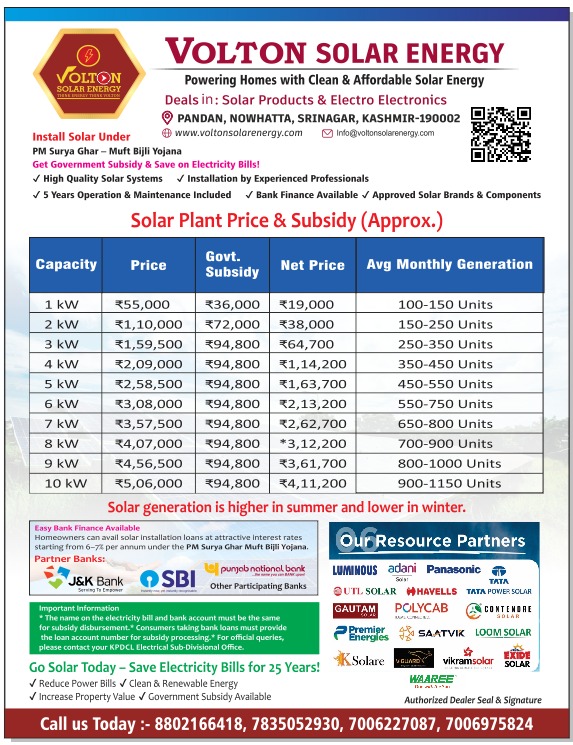
Volton Solar Energy Plant Prices and Subsidy Details (Srinagar, J&K)
Eligibility Criteria
The government does not hand out thousands of rupees without strict compliance checks. They have established highly specific solar yojana eligibility rules to prevent corporate exploitation of the residential fund.
First, the applicant must be an Indian citizen. Secondly, you must legally own the physical property where the hardware will be installed. You cannot claim this specific state subsidy for a rented apartment unless the actual legal landlord registers the application in their own name.
Your property must have a valid, fully active electricity connection provided by a recognized state distribution company. You also need a clear, structurally sound roof space that receives adequate direct sunlight. Finally, the primary applicant must hold an active bank account that is permanently linked to their Aadhaar card to successfully receive the digital cash transfer. Commercial offices and industrial factories are strictly banned from applying to this specific domestic pool.
Documents Required
Failing to provide the correct paperwork is the primary reason applications get rejected. You must gather highly specific solar scheme documents before you even open the registration portal. Keep the following official records scanned and ready:
- A clear copy of your Aadhaar Card for strict identity verification.
- Your latest official electricity bill generated within the last 60 days.
- A cancelled cheque or a copy of your active bank passbook for the payout.
- Recent passport size photographs of the primary applicant.
- Valid property ownership proof or the most recent municipal house tax receipt.
How to Apply for Solar Panel Yojana (Step by Step)
The days of submitting paper applications at a dusty local electricity office are completely over. The entire registration process is now strictly digital. You must follow these exact operational steps to successfully apply solar yojana funding to your property.
- Open your web browser and navigate strictly to the official national portal at https://pmsuryaghar.gov.in/
- Register your basic consumer profile. You will need to select your specific state, your local electricity distribution company, and input your exact consumer account number.
- Log into the portal using your registered mobile number and fill out the formal rooftop solar application form.
- Wait for the official feasibility approval. Your local electricity board must verify your grid capacity. This typically takes around 7 to 10 business days.
- Once your application status changes to approved, select a certified installation vendor directly from the official portal database.
- After the physical installation is complete, upload the final plant details to the portal and formally apply for your net meter upgrade.
- Local grid officials will visit your property to physically inspect the setup. If it meets all safety standards, they will generate an official commissioning certificate.
- Submit your bank account details alongside this new certificate on the portal to trigger your final ₹78,000 payout.
Cost of Solar System After Subsidy
The financial return on investment becomes incredibly clear when you look at the actual market data. Let us break down the exact solar panel price after subsidy for a typical middle class home. The standard current market rate for a high quality, tier one 3kW solar plant is roughly ₹1,60,000. This includes the panels, the inverter, the mounting structures, and the physical labour.
When you successfully apply the maximum ₹78,000 government grant, your actual out of pocket expense drops heavily to just ₹82,000.
Furthermore, many major nationalised banks are now aggressively offering highly subsidised green energy loans at interest rates around 7%. This specific financing covers the remaining ₹82,000 balance. In practical terms, this means your new monthly loan EMI will actually be significantly lower than the massive electricity bill you were previously paying. You essentially acquire a highly valuable green energy asset for zero net monthly cost.
Benefits of Solar Panel Yojana
The immediate financial relief is the primary driver for most households. You completely eradicate those massive summer cooling bills that constantly ruin your monthly budget.
But the long term solar benefits India offers are far more lucrative. The physical system typically pays for itself entirely within 36 to 48 months. Because standard tier one solar panels come with a strict 25 year performance warranty, you are effectively securing over two decades of completely free power after your break even point.
Additionally, the new net metering regulations allow you to export any excess generated power directly back into the local grid. Your electricity provider tracks this exported power and applies a financial credit to your account, essentially allowing you to generate a small passive income during the cooler winter months.
Common Mistakes to Avoid
Thousands of eager homeowners face brutal application rejections every single month due to basic administrative errors. The most common solar yojana mistakes involve the vendor selection process.
You will instantly lose your legal right to the entire ₹78000 subsidy if you hire a cheap & unregistered local electrician to install your panels. You must strictly use a vendor officially listed on the national portal.
Another massive operational error is failing to match your banking details. The exact name printed on your bank account must perfectly match the name printed on the original electricity bill. The automated government verification software will instantly freeze the payment transfer if these two primary names do not align perfectly.
Solar Panel Yojana FAQs
We have actively compiled the most urgent solar panel yojana faq searches to clear up any remaining market confusion.
What is Solar Panel Yojana 2026?
It is the broad public term used to describe the central government initiative, primarily the PM Surya Ghar scheme, which provides massive direct cash subsidies for residential rooftop solar installations.
How much subsidy is available under the Solar Panel Yojana?
The government transfers exactly ₹30,000 for a 1kW setup, ₹60,000 for a 2kW setup, and a maximum capped limit of ₹78,000 for any system sized 3kW or larger.
A special category multiplier is applied in J&K due to high terrains. A basic 1kW system secures exactly ₹36,000. Upgrading to a 2kW setup pulls in ₹72,000. For any larger residential setup ranging anywhere from 3kW up to 10kW, the absolute maximum cash limit is pushed aggressively to ₹94,800.
Who is eligible for Solar Panel Yojana in India?
The funding is strictly reserved for Indian citizens who legally own their residential roof space, maintain a valid and active electricity connection, and hold an Aadhaar linked bank account.
How can I apply for Solar Panel Yojana 2026?
You must submit your application strictly online through the official government portal located at pmsuryaghar.gov.in. Manual paper applications are entirely banned.
Is there any free solar panel scheme in India?
No. You must absolutely pay the certified installation vendor first. The government then returns a fixed subsidy percentage directly to your bank account later. Any claims of 100% free hardware are total financial frauds.
Conclusion
Transitioning your home to renewable energy is arguably the smartest financial move you can possibly make this year. This complete solar yojana guide clearly proves that the central government is fully backing residential green energy adoption with heavy cash incentives.
With up to ₹78,000 in direct bank transfers available right now, the pure return on investment is absolutely undeniable.
Gather your property documents, visit the official government portal today & totally cut your financial ties with rapidly rising grid electricity prices.
Need Help with Solar? We’re Here for You
Get FREE help for installation, cleaning, subsidy guidance, or any solar queries — talk to our expert team and get the right advice today.