The extreme northern regions of India are currently undergoing a massive structural shift in energy generation. For decades, Jammu, Kashmir, and Ladakh have relied heavily on highly expensive diesel generators, complex grid transmission across steep mountain passes, and volatile state utility tariffs.
However, entering 2026, the financial and operational landscape has completely transformed. The regional solar market is no longer a niche environmental initiative. It is a rapidly expanding financial sector driven by massive state subsidies and commercial necessity.
This guide breaks down the exact market size, the primary growth drivers, and the lucrative future opportunities within the J&K and Ladakh renewable energy sectors.
Market Size and Current Landscape
| Category | Details |
|---|---|
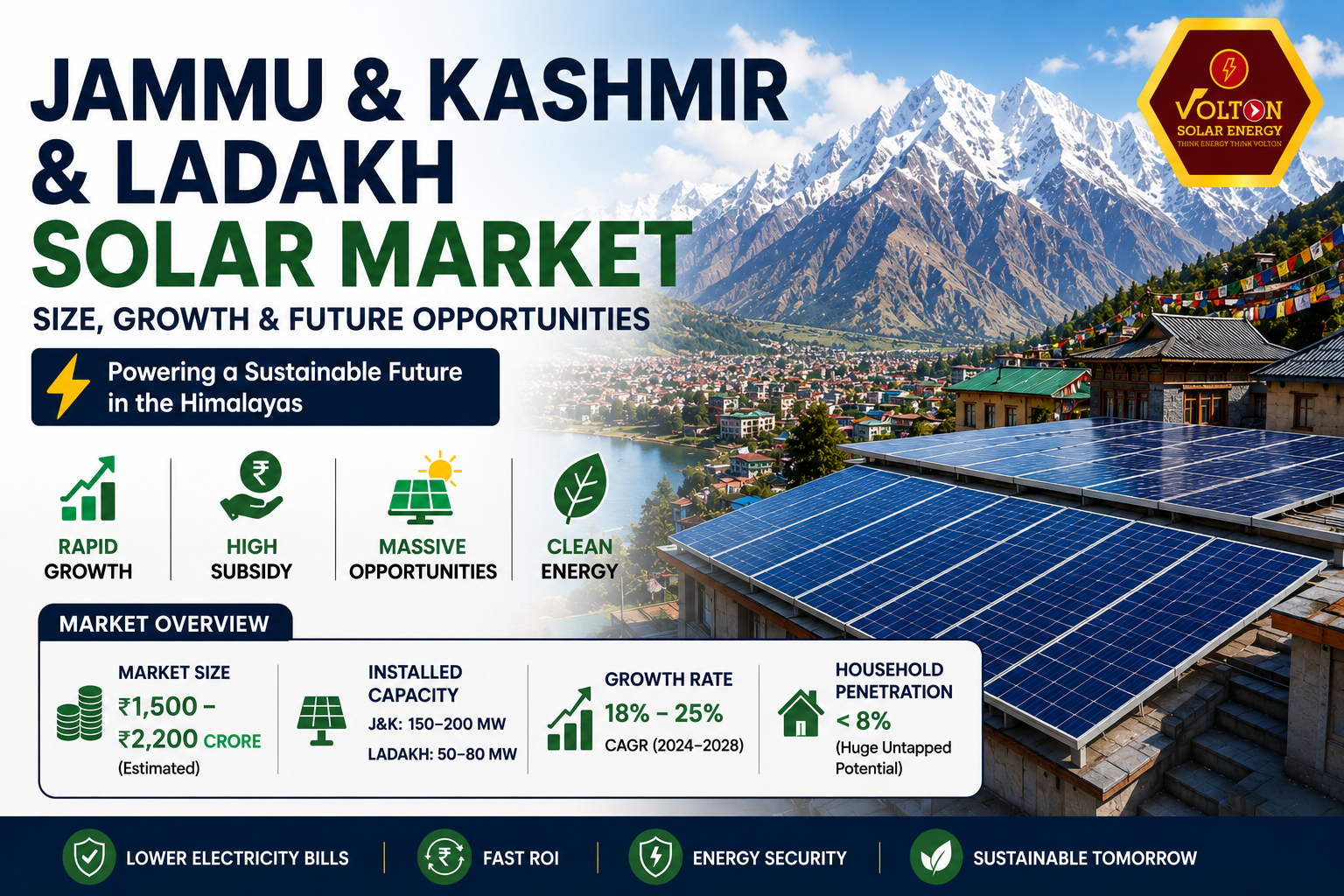
| Market Valuation | ₹1,500–₹2,200 crore (2026) |
| Installed Capacity (J&K) | ~150–200 MW rooftop + ground solar |
| Installed Capacity (Ladakh) | ~50–80 MW (off-grid & microgrid) |
| Growth Rate | 18%–25% CAGR (2024–2028) |
| Household Penetration | <8% homes using solar |
Despite rapid growth, solar penetration remains under 10%, indicating massive untapped demand.
The combined solar market across these high altitude union territories is experiencing unprecedented year on year growth. Historically, deployment was incredibly slow due to extreme weather conditions and heavy logistical costs. Today, advanced tier one solar technology and heavily reinforced mounting structures have entirely solved these physical hurdles.
The central government currently classifies J&K and Ladakh as special category regions under the flagship PM Surya Ghar Muft Bijli Yojana. This specific classification legally unlocks significantly higher capital grants compared to the rest of the country.
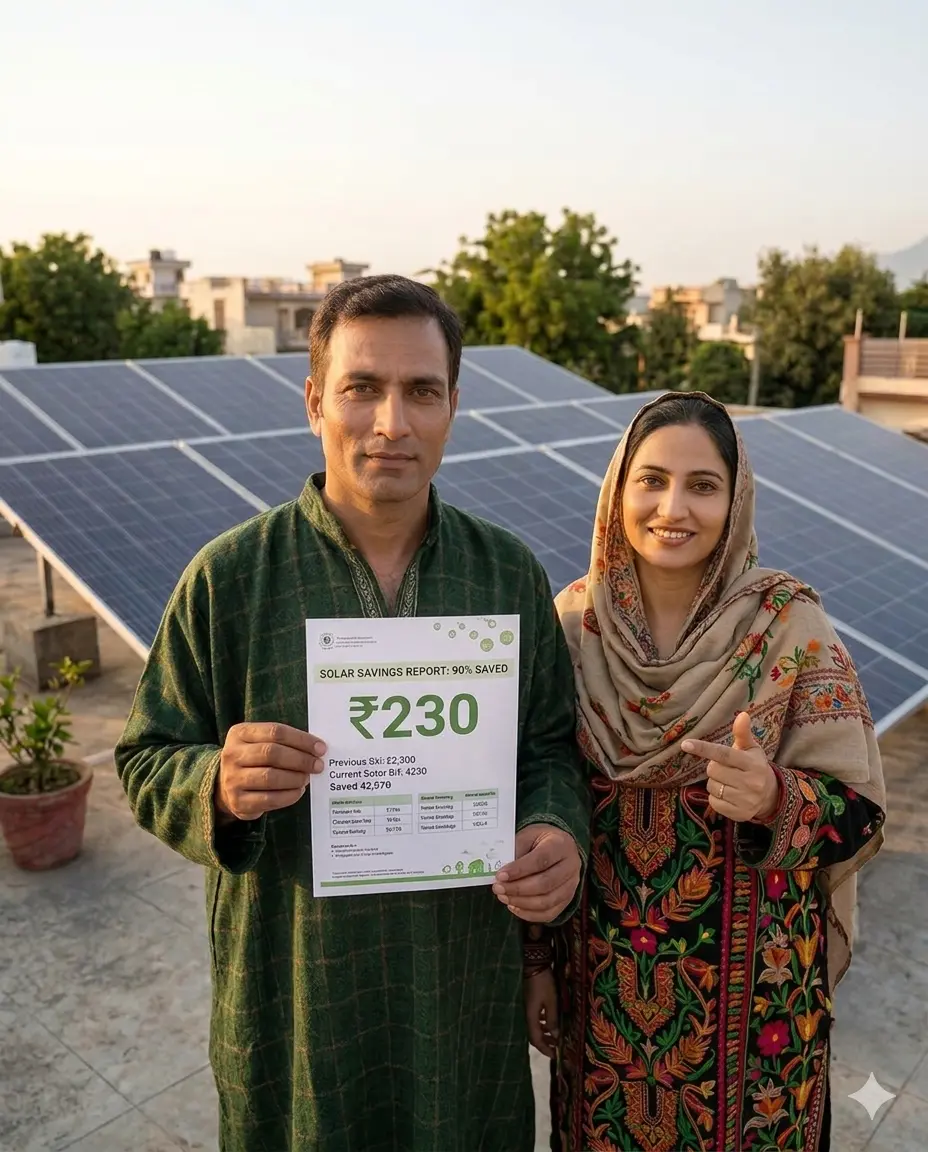
For homeowners and businesses, solar installation in Srinagar is rapidly becoming the most cost-effective solution to tackle rising electricity costs and winter power cuts.
For a standard 3kW residential setup, homeowners in J&K can secure a maximum of ₹94,800 in direct bank transfers. This aggressive financial injection has rapidly expanded the total addressable market, moving rooftop solar from a luxury upgrade to a standard household utility.
Key Growth Drivers
At the same time, solar installation in Jammu is witnessing strong demand as commercial establishments look to reduce long-term operational expenses. Besides, several strict financial and geographical factors are aggressively driving this regional market expansion.
First, the region faces severe winter power deficits. Homeowners and local businesses are actively installing hybrid solar setups with deep battery storage to maintain daily operations during heavy snowstorms and highly scheduled grid outages.
Secondly, Ladakh is operating under a strict government mandate to become a fully carbon neutral territory. The local administration is pouring massive capital into off grid solar microgrids to completely eradicate diesel dependency in remote Himalayan villages.
Finally, the commercial and industrial sectors in Jammu and Srinagar are desperately trying to lower their overhead costs. Hotels, cold storage units, and manufacturing plants are aggressively deploying massive rooftop solar arrays to permanently stabilize their operational expenses. With these commercial setups, local businesses are dropping their capital break even timelines to just under four years.
Future Opportunities and Investment
| Opportunity | Market Insight |
|---|---|
| Battery Storage | 3x demand growth by 2028 |
| Off-grid Systems | 60% Ladakh villages still off-grid |
| Installation Market | <100 certified vendors |
| Government Projects | ₹5,000+ crore renewable push |
For commercial investors and local entrepreneurs, the 2026 regional roadmap is incredibly lucrative.
The absolute biggest future opportunity lies in advanced battery energy storage systems. Because standard on grid systems must legally shut down during state grid failures for safety reasons, the demand for high capacity lithium storage solutions in Kashmir and Ladakh is skyrocketing. Whoever controls the supply of reliable winter batteries will dominate the off grid sector.
Across the valley, solar installation in Kashmir is expanding quickly due to high subsidy benefits and increasing awareness of energy independence.
Furthermore, there is a massive regional deficit of officially certified installation vendors. Authorized companies that deeply understand local grid regulations and can effectively navigate the complex PM Surya Ghar subsidy portal are actively capturing massive market share.
Solar System Cost Breakdown
| System Size | Total Cost | Subsidy | Net Cost |
|---|---|---|---|
| 1kW | ₹70,000–₹85,000 | ₹30,000 | ₹40K–₹55K |
| 2kW | ₹1.3L–₹1.6L | ₹60,000 | ₹70K–₹1L |
| 3kW | ₹2L–₹2.4L | ₹94,800 | ₹1.1L–₹1.5L |
This subsidy covers up to 40–50% of total system cost in special category regions like J&K.
Providing comprehensive end to end services from physical site surveys to final net meter activation represents a highly profitable business model for regional tech startups and engineering firms.
Conclusion
The renewable energy market across Jammu, Kashmir, and Ladakh has officially reached its tipping point. The heavy combination of rising utility tariffs, aggressive government cash subsidies, and the urgent need for winter power security makes this specific region the most dynamic solar sector in the entire country.
Whether you are a private homeowner looking to crush your monthly electricity bills or an investor seeking high yield commercial opportunities, the northern solar market offers undeniable financial returns.
ROI by Segment
| Segment | Avg System Size | ROI Period | Savings |
|---|---|---|---|
| Hotels | 20kW–100kW | 3–4 years | 60–80% |
| Cold Storage | 30kW–150kW | 3–5 years | Stable cost |
| Small Industry | 10kW–50kW | 3–4 years | High ROI |
The transition to decentralized green energy in the Himalayas is no longer just a future concept. It is an active, rapidly expanding financial reality.
Ready to Switch to Solar in J&K or Ladakh?
Get expert consultation, subsidy assistance, and end-to-end solar installation services tailored for high-altitude regions. Reduce your electricity bills and ensure reliable power even during extreme winters.
Free site survey | Government subsidy support | Fast installation